 A.I.
A.I.
Hardware · Chips
Maia 200 and Maia 300
Maia 200 is the AI chip Microsoft designs for its own Azure data centers. It is built for inference, which is running a trained model to answer requests, rather than for training. Microsoft announced it on 26 January 2026 (Microsoft, Maia 200: The AI accelerator built for inference).
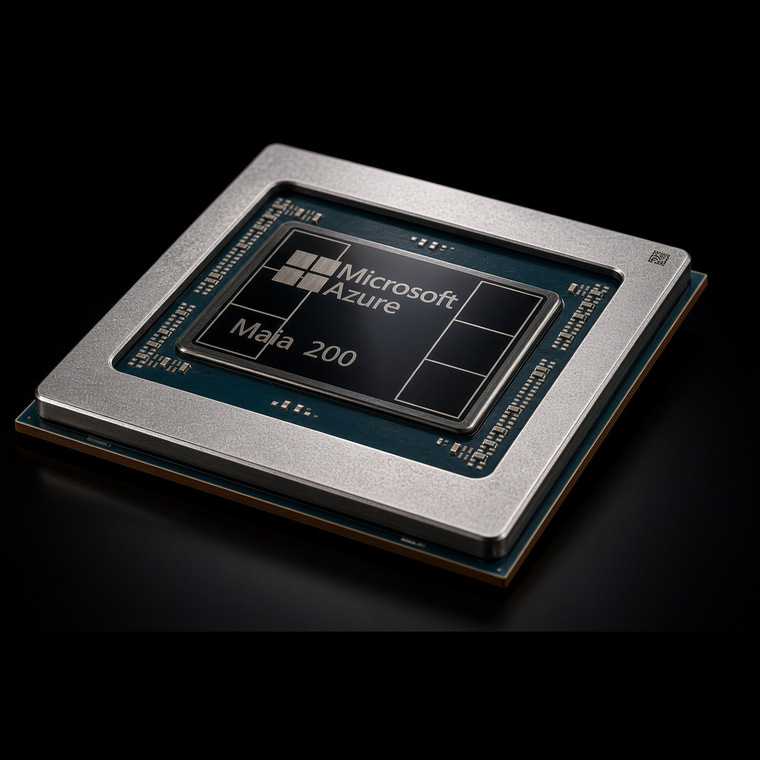
The chip
Microsoft's figures for one Maia 200 chip:
| Figure | One Maia 200 chip |
|---|---|
| Process | TSMC 3nm |
| Transistors | Over 140 billion |
| FP4 | Over 10 PFLOPS |
| FP8 | Over 5 PFLOPS |
| Memory | 216 GB HBM3e at 7 TB/s |
| On-chip SRAM | 272 MB |
| Power (SoC TDP) | 750 W |
| Scale-up bandwidth | 2.8 TB/s, both directions |
FP4 and FP8 store each number in 4 or 8 bits. Fewer bits means faster math with less precision, which suits inference. A PFLOPS is a thousand trillion math operations per second. HBM3e is high-bandwidth memory stacked next to the chip. SRAM is a smaller, faster memory on the chip itself. TDP is the most power the chip is built to draw. Scale-up bandwidth is how fast one chip talks to the others in its group.
What Microsoft claims
Microsoft says Maia 200 has three times the FP4 performance of Amazon's third-generation Trainium and FP8 performance above Google's seventh-generation TPU, Ironwood. It also says Maia 200 gives 30% better performance per dollar than the latest hardware in its fleet. These are Microsoft's own claims, not outside test results.
Systems
Each tray holds four Maia chips wired straight to each other with no switch in between. Racks and clusters connect over standard Ethernet using Microsoft's own Maia AI transport protocol, up to 6,144 chips in one cluster. The racks use Microsoft's second-generation closed-loop liquid cooling.
Where it runs
Microsoft says Maia 200 is deployed in its US Central region near Des Moines, Iowa, with US West 3 near Phoenix, Arizona, next. It will serve models including OpenAI's GPT-5.2 in Microsoft Foundry and Microsoft 365 Copilot. Microsoft's Superintelligence team will use it to generate synthetic data, which is training material made by a model, and for reinforcement learning, which trains a model by rewarding good answers.
On 12 October 2026, Microsoft CEO Satya Nadella said Maia 200 is now being deployed across the US, Europe, and Australia (Satya Nadella on X, 12 Oct 2026). He said it delivers "up to 1.7x more tokens per watt" in Teams and Copilot. A token is a small chunk of text, often part of a word, that a model reads or writes, so tokens per watt measures how much AI output a chip produces for each unit of power it uses. Microsoft's blog says the comparison is with leading GPU infrastructure; it is Microsoft's own figure (Official Microsoft Blog, 12 Oct 2026).
In the same post, Nadella said that starting next calendar year Microsoft will scale the Maia family to multi-gigawatt deployments, meaning data center capacity drawing billions of watts, and make it the primary inference system for Microsoft's own products and services.
Maia 300
Microsoft announced Maia 300, the third generation of Maia, on 12 October 2026 (Official Microsoft Blog, Azure Blog deep dive). Like Maia 200 it is built for inference. Microsoft says production deployments begin in 2027. Every figure below is Microsoft's own, not an outside test.
One Maia 300 chip
| Figure | Maia 300 | Maia 200 |
|---|---|---|
| Process | Several chiplets; compute die on TSMC N2P | One die, TSMC 3nm |
| Memory | 288 GB HBM4, 8 stacks | 216 GB HBM3e |
| Memory bandwidth | 18 TB/s | 7 TB/s |
| Power (TDP) | 950 W | 750 W |
| FP4 and FP8 compute | not stated in the blog text | Over 10 PFLOPS FP4 |
A chiplet is one of several smaller dies joined in one package, so each job can use the factory process that suits it. N2P is a TSMC 2-nanometer-class process. HBM4 is the generation of stacked high-bandwidth memory after HBM3e. Microsoft says the chiplet design gives 36% more compute than Maia 200, and 2.5 times the memory bandwidth, 33% more memory, and about twice the memory bandwidth per watt.
The rack
| Figure | One Maia 300 rack |
|---|---|
| Chips | 96, in 24 trays of 4 |
| Rack power | 167 kW |
| Memory | 27.6 TB HBM |
| Memory bandwidth | 1.7 PB/s combined |
| Cooling | Liquid removes more than 80% of the heat |
A kW (kilowatt) is a thousand watts. A PB/s (petabyte per second) is a thousand TB/s. Each tray holds four chips with their own host processor, so there are no separate host trays, which Microsoft says doubles the chips per rack versus Maia 200.
The superpod
Racks connect over an Ethernet-based network with Microsoft's own AI transport. Second-tier switches link up to 128 racks into a superpod of up to 12,288 chips, and any chip can send up to 750 GB/s to any other chip in it.
What Microsoft claims
- 40% more tokens per megawatt than leading GPU-based systems. The blog does not name the GPU systems. Nadella's post says "per watt."
- Up to 7 times the rack-scale token throughput of Maia 200, with all 96 chips.
- More than 2.5 times the performance per watt of Maia 200.
Microsoft says it will scale Maia to multi-gigawatt deployments starting in 2027 and make it the primary inference system for its own products (Satya Nadella on X, 12 Oct 2026).
Sources
- Microsoft, Maia 200: The AI accelerator built for inference (26 Jan 2026)
- Microsoft, Maia 200
- Official Microsoft Blog, Microsoft to expand Azure Maia system to multi-gigawatt deployments (12 Oct 2026)
- Azure Blog, Deep dive into Azure Maia 300 architecture (12 Oct 2026)
- Satya Nadella on X, Maia 200 deployment and Maia 300 (12 Oct 2026)
- Ironwood
- Trainium2