 A.I.
Hardware · Chips
Intel GPU D270
The Intel GPU D270 is a data center accelerator built only for inference, which means running an already trained AI model to answer requests, not training one. Intel announced the GPU D-series on 12 October 2026 (Phoronix, Intel Announces The GPU D Series For Crescent Island (12 Oct 2026)). At the Open Compute Project (OCP) Global Summit, a yearly data center hardware conference, Intel shared new technical details in its newsroom post (Intel, Intel Accelerates Open Infrastructure for the Agentic AI Era (OCP Global Summit 2026)). Intel first announced Crescent Island on 14 October 2025 (Intel, Intel to Expand AI Accelerator Portfolio with New GPU (14 Oct 2025)).
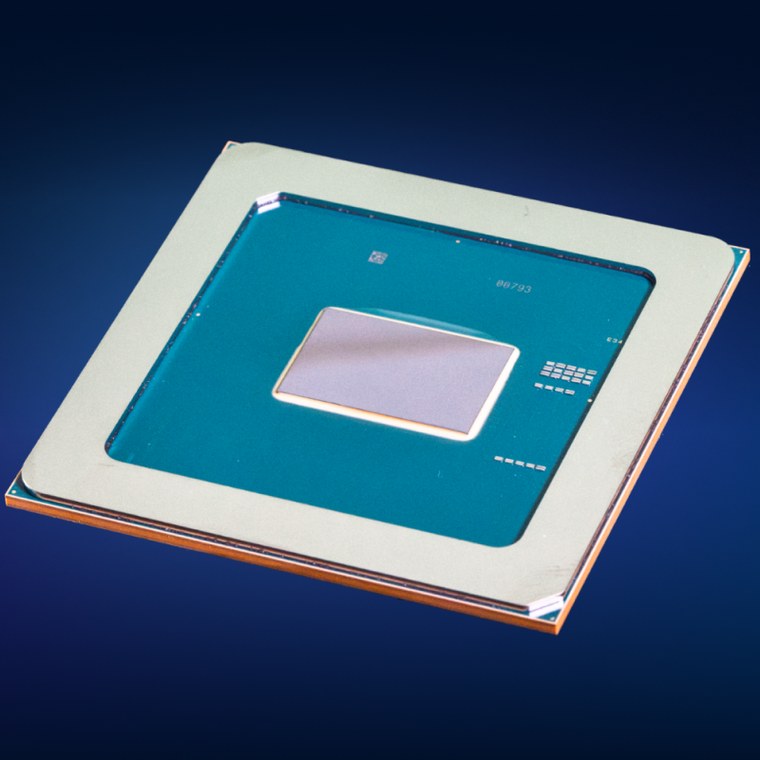
The card
Intel states the figures below in [1] and on the Intel, Intel GPU D270, Inference-Optimized Data Center GPU (product page). Intel does not say whether the FP8 compute figure is dense or sparse.
| Figure | Intel GPU D270 |
|---|---|
| Architecture | 32 Xe3P cores, 256 XMX Xe3P matrix engines |
| Compute | 1.3 PFLOPS FP8 |
| Number formats | From native low-precision inference to FP64 scientific computing; Intel does not list formats |
| Memory type | LPDDR5X |
| Memory size (Intel branded PCIe card) | 160 GB LPDDR5X |
| Memory size (partner ODM cards) | Up to 480 GB LPDDR5X per card |
| Memory bandwidth | 1.5 TB/s |
| Power | 350 W, air-cooled |
| Form factor | Standard PCIe 5.0 |
| Cooling | Passive cooling in existing racks; no liquid-cooling retrofit |
| Model size, one card | Up to 300 billion parameters on a single card |
| Model size, eight cards | More than one trillion parameters in an eight-GPU system |
| Status | Customer sampling underway |
A PFLOPS is a thousand trillion math operations per second. FP8 stores each number in 8 bits. LPDDR5X is low-power memory like that in laptops and phones, not HBM (high-bandwidth memory stacked next to the chip). PCIe is the standard slot plug-in cards use in ordinary servers. Parameters are the numbers a model learned in training; more parameters need more memory. ODM means a contract maker who builds cards under its own brand. Air-cooled and passive here mean the server's fans move heat, with no water lines.
Intel card vs partner cards
Intel states that its own branded PCIe card carries 160 GB of LPDDR5X, while the design lets partners build ODM branded cards with flexible options up to 480 GB [1]. Reported by Moor Insights & Strategy, Matt Kimball, Where Intel's GPU D270 Fits In Enterprise AI (16 Oct 2026): Dell, HPE, Lenovo, and Supermicro are named as system partners, and Moor says Intel's own card ships with 160 GB while ODM partners can build cards with up to 480 GB [4]. Intel does not list which partner ships a 480 GB card or when.
Reported by Moor: the 300-billion-parameter single-card claim belongs to the 480 GB partner cards; on the 160 GB Intel card, a model that size fits only at roughly 4-bit precision, with little room left for context [4]. Intel does not state what precision or context length the 300B claim assumes.
What Intel claims
These are Intel's own claims, not outside test results. No independent tests yet.
- Intel calls the D270 an inference-optimized data center GPU designed for the agentic AI era, and says it moved chip area from graphics and ray-tracing pipelines to Xe3P cores and matrix compute [1], [2]. Reported by Moor: the graphics and ray-tracing hardware are gone [4].
- Intel targets enterprise AI, SaaS, GPUaaS, and government or sovereign-cloud deployments that need memory-rich, power-efficient AI acceleration [2]. Workloads include agentic AI, long-context RAG (retrieval-augmented generation, looking up documents before answering), assistants, coding assistants, document understanding, multimodal models, diffusion, and high-concurrency serving [2].
- Intel's pitch against HBM chips: fewer GPUs and no HBM, working within existing data centers without specialized rack or cooling infrastructure [1], [2]. For contrast, the Rubin GPU is listed on this site at 19.2 TB/s of memory bandwidth on liquid-cooled racks [8]. The D270 trades speed for capacity: slower memory (1.5 TB/s), with partner cards holding up to 480 GB, more than Rubin's 288 GB. Intel's own 160 GB card holds less. It fits ordinary air-cooled servers.
- Reported by Moor: capacity is the pitch, not speed; Moor compares the D270 with PCIe server cards such as Nvidia's RTX PRO 6000 Blackwell Server Edition, not flagship HBM chips [4].
- Intel's product page footnote says performance projections versus RTX Pro 6000 are based on publicly available information and Intel internal analysis as of February 2026; the page we cite shows no number for that comparison [2].
Software
Intel states the card runs on a common Xe software foundation that supports software portability across Intel GPU platforms [1]. The product page lists zero-day support for leading open models on vLLM and the open PyTorch ecosystem [2]. vLLM is popular open-source software for serving models, and PyTorch is a widely used AI toolkit. Intel cites Day 0 support for Meta's Muse Glimmer [1]. Reported by Moor: SGLang, another model-serving program, is also in the stack [4].
What is not known
- Price. Intel names no price; the product page asks readers to connect with Intel for updates [2].
- Intel-stated general availability date. Intel says only that sampling is underway [1]. Reported by Moor: broader availability in 2027; no Intel page we cite gives 2027 [4].
- Whether the 1.3 PFLOPS FP8 figure is dense or sparse [1].
- Which partners ship 480 GB cards, and when.
- What precision and context length the 300-billion-parameter-on-one-card claim assumes, and whether it holds on the 160 GB Intel card.
- Independent benchmark results. MLCommons, Where the Industry Is Investing: A Look at MLPerf Inference v6.1 (17 Sep 2026) shows Intel with Xeon and Arc Pro B70 systems, not D270 [6]. Intel's v6.0 entry used Arc Pro B70 and B65, per Intel, Intel Delivers Open, Scalable AI Performance in MLPerf Inference v6.0 (1 Apr 2026). Reported by Moor: there is no independent performance data yet [4].
Sources
- Intel, Intel Accelerates Open Infrastructure for the Agentic AI Era (OCP Global Summit 2026)
- Intel, Intel GPU D270, Inference-Optimized Data Center GPU (product page)
- Intel, Intel to Expand AI Accelerator Portfolio with New GPU (14 Oct 2025)
- Moor Insights & Strategy, Matt Kimball, Where Intel's GPU D270 Fits In Enterprise AI (16 Oct 2026)
- Phoronix, Intel Announces The GPU D Series For Crescent Island (12 Oct 2026)
- MLCommons, Where the Industry Is Investing: A Look at MLPerf Inference v6.1 (17 Sep 2026)
- Intel, Intel Delivers Open, Scalable AI Performance in MLPerf Inference v6.0 (1 Apr 2026)
- Rubin (rycode.dev)